
I had the idea. I spent some time researching and transforming the spark into a premise with series potential. Now I had to write the outline. Well, I didn’t HAVE to. Time for a disclaimer. This is my process for writing THIS project, a romantic adventure/thriller with speculative elements that spans 40,000 years of human history… it was always going to be a big project that required a decent foundation in order to get started. This is not how I would usually approach a novel… five years of researching, percolating and planning is, I think, generally a bit excessive (and I went back to university to get my Masters degree within this time, too) but for this project it definitely required the extra pre-work attention. However, I’m not suggesting this is the best or only way to craft a novel. Every writer has their own way of working, and that’s cool. Being a creative is a highly personal and intimate thing. There are as many correct ways to do it as there are people who want to write… i.e unlimited ways to go about it. Sometimes it helps to see how other writers go about crafting their stories. So again, this is how I am writing THIS book, I’m not saying this has more or less merit than any other way, just that this is how I found myself progressing with this challenging project.
I am an outliner. No pantsing for me. I have done the pantsing thing. I have written more than a million words across all the creative projects I have completed, and I know spending that pre-writing time doing basic research, planning and outlining works for me. My scatterbrain loves the structure. It loves to know where on the literary map I plan to take it. At least, it loves to have a general idea. I definitely don’t plan to death. I believe you need to allow a story space to develop, to grow, to veer off the designated path if it really wants to go the scenic route – and the scenic route works for the story. I like to think about the planning and outlining stage as a willow tree, growing sturdy and strong but also having the ability to bend in the wind, so it doesn’t break. I like the organic feel of the early outline stage. And I like to leave room for development of not only the book, but the series, even if I have plotted the trajectory of all five books – which I have. To know every detail down to the minutiae would take more time than I would want to give the early part of the process, and it would take away the magic of wondering What Will Happen Next? Yes, I might have a good idea where I’m going, but I want a bit of writing jeopardy, a bit of suspense and to know I can be surprised, it keeps the motivation levels up.
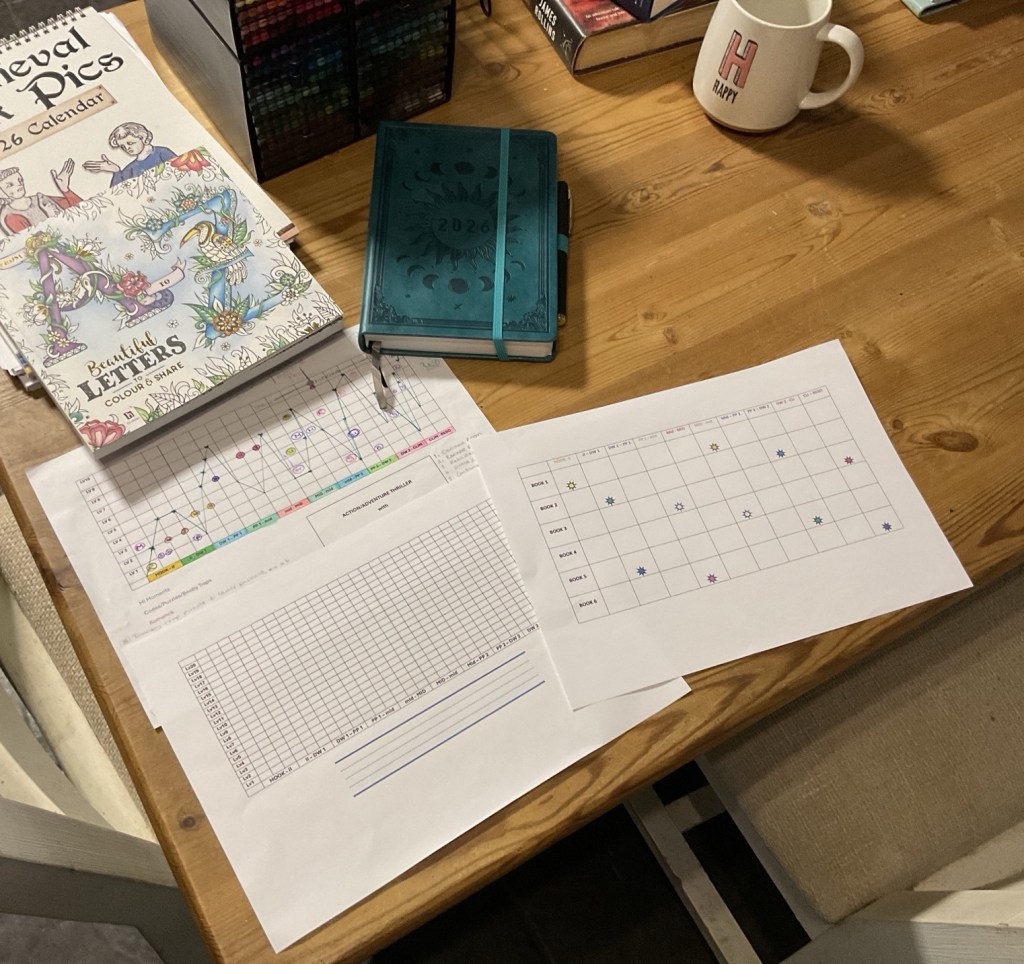
The outline stage of this project has been, admittedly, a bit messy. I have compiled multiple versions… I have found it difficult to hone in on exactly the style and tone and even the mix of genres that I wanted for this pentalogy. Having completed an outline I’m relatively satisfied with, I know I want the Happily-Ever-After feeling I love in a romance novel, with the high-stakes finale of an action-adventure-thriller. There is still the option for a coda at the end of book five – and here is the leaving room for refining part in play – but that is something for Future Me to worry about. Because right now I am in a place where FINALLY I can begin to write book 1. Outline complete. Starting flag waiting to be waved. And that brings me to the rough draft. I love a rough draft, it’s essentially a more detailed outline. And it’s the topic of the next post… I’d love to hear about your writing projects in the comments below, or even what books you are reading at the moment or have on your TBR list. Tell me about your early writing stages, or if you can tell if a book has been plotted to death or not plotted enough…
 HEIDI CIECIURA #thrillerwithlove
Leave a comment